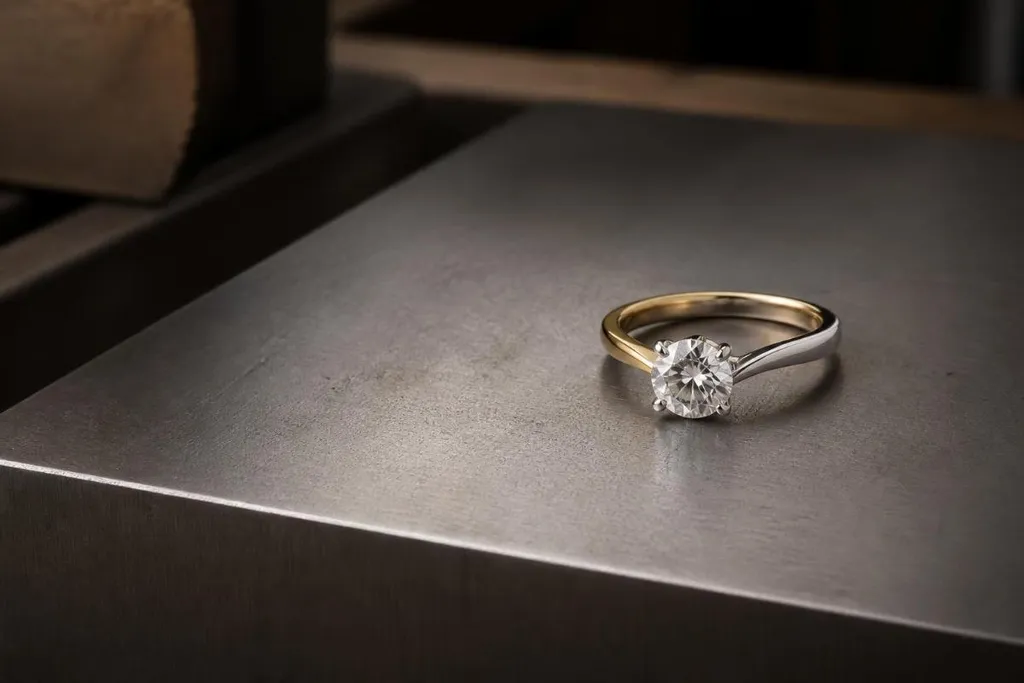
Choosing a ring metal is often presented as a single decision: yellow gold, white gold, rose gold or platinum. A two-tone setting removes that limitation. By combining contrasting metals within one design, it becomes possible to change how the centre stone is framed while keeping the band aligned with the wearer's preferred jewellery colour. The result can be subtle enough to notice only on closer inspection or deliberately contrasting for a stronger bespoke character.
For someone refining an existing engagement-ring design, this upgrade offers a way to introduce mixed metals without abandoning the fundamental proportions of the setting. The key is deciding where each metal should appear and understanding how those choices affect the centre stone, band and eventual bridal stack.
Why Use Two Metals Instead of One?
Mixed-metal settings are useful because different parts of an engagement ring perform different visual roles.
The band creates the dominant metal colour around the finger. The claws, basket or other components immediately surrounding the centre stone influence how that gemstone appears. Using one metal for the band and another around the stone allows those areas to be treated separately.
A yellow gold band with white-toned claws is a classic example. The shank provides warmth and coordinates naturally with yellow gold jewellery, while the lighter setting around a colourless diamond can appear less visually prominent.
The reverse approach creates a very different effect. Warm-toned setting details against a white-metal band make the construction more noticeable and can give the ring an intentionally individual character.
Two-tone design therefore has a practical styling purpose. It is not simply about adding another colour; it allows the visual relationship between the gemstone and the rest of the ring to be adjusted more precisely.
How Mixed Metals Affect the Centre Stone
The metal immediately surrounding a diamond or gemstone can influence its perceived outline.
White-toned claws often blend more readily with a colourless diamond. At normal viewing distance, this can reduce the apparent interruption created by the setting and keep attention on the stone itself.
Yellow or rose-toned claws create stronger contrast. That may be desirable when the wearer wants the craftsmanship of the setting to remain visible or when warm metal is central to the overall aesthetic.
Centre-stone size also changes the equation. Someone choosing a 2-carat diamond might prefer a contrasting two-tone setting because the larger stone has enough presence to remain dominant even when the surrounding metal is visible. With a more delicate centre, a lighter-toned setting may help reduce visual competition.
Stone shape deserves consideration as well. Oval and round stones can be softened or sharpened by contrasting prongs, while emerald, radiant and other geometric cuts may respond particularly well to clean white-metal details around their defined edges.
Creating a More Personal Bridal Stack
A two-tone engagement ring can make wedding-band selection considerably more flexible.
Someone who wears both yellow and white metals does not necessarily have to choose one permanently for the complete bridal set. A yellow gold wedding band can connect with the engagement ring's shank, while white-metal details around the centre stone still coordinate with platinum or white gold jewellery elsewhere.
Mixed-metal stacks can also look more intentional when the engagement ring already establishes the combination. Instead of a different-coloured wedding band appearing accidental, the two-tone engagement ring provides a visual bridge between the metals.
Balance is important. If the engagement ring already contains a noticeable contrast, a relatively simple wedding band may allow that detail to remain clear. Adding several metals, diamond patterns and textures simultaneously can make a bridal stack feel unnecessarily complicated.
A restrained approach usually gives the individual metal choices more impact.
What to Consider Before Choosing the Upgrade
Two-tone design works best when there is a reason behind the placement of each metal.
Consider which colour you want to see most when looking at your hand. Because the band occupies a large proportion of the visible ring, its metal will usually establish the overall tone. The centre setting can then either blend with that colour or provide deliberate contrast.
Existing jewellery is another useful reference. Someone who consistently wears yellow gold watches, bracelets and necklaces may prefer a warm band even if they like the discreet appearance of white-toned claws around a diamond.
Long-term styling matters too. Engagement rings are designed to outlast short-lived jewellery trends, so the combination should reflect colours the wearer genuinely enjoys rather than novelty alone.
Normal care will depend on the specific metals used. Periodic professional inspections can also ensure that the centre setting remains secure and the contrasting finishes continue to look their best.
Final Thought
A two-tone ring setting proves that metal choice does not have to be an either-or decision. By assigning different colours to the band and centre setting, a familiar engagement-ring design can gain a noticeably more individual identity.
The most successful combinations are purposeful: one metal complements the centre stone while the other connects the ring to the wearer's broader style. It is a relatively subtle customisation, yet one capable of changing how the entire ring is perceived.